
The Two Routes That Raise Your Breaking Rate
Your breaking rate has two inputs, and both are paid for with Cash from the zone you farm:
- Power, from pickaxes. One number in the shop, 1 to 15,000,000,000 across 18 tiers.
- Speed, from training and Treadmills. How fast you move between eggs, and how many trips you complete.
They are not interchangeable. A pickaxe does nothing about travel time, and Speed does nothing about a shell that still needs more hits. This page covers the pickaxe side; the Speed side has its own planner.
One warning before the numbers: Power is the shop stat. We do not have the game's egg HP table, and we cannot confirm that one hit removes exactly that many Power from a shell. So treat Power as a comparable stat between pickaxes, not as a countdown to a crack.
What One Power Point Costs at Every Tier
Four bands, not one ladder. Each band is a different buying problem: the first is about unlocking, the last is about whether a pickaxe is still the right purchase at all.
Tiers 1-3: the cheap opening
$0 to $800Wooden comes free and Stone costs $80, so the first two tiers cost less than a single egg run. Iron is where the price of Power starts to matter: $53 per point, still the cheapest paid Power in the game.
1Wooden
2Stone
3Iron
What this band means: buy both, in order, the first time you can afford them. Nothing else in the game gives you that much breaking Power for under $1,000.
Tiers 4-6: the first expensive step
$20K to $1.2MGolden is the steepest step on the whole ladder: Power goes up x4 but the price per point jumps x6.3. Diamond and Strawberry then settle back to about x1.9, which makes them the cheapest relative jumps of the mid-game.
4Golden
5Diamond
6Strawberry
What this band means: Golden is the first tier where saving for the next pickaxe costs you real time. From Diamond on, take each tier whole instead of buying half-measures.
Tiers 7-11: where every step slows down
$6M to $20BFive tiers, each one adding about x4 Power while the price of that Power multiplies between x1.3 and x1.8. Cactus is the smallest increase on the table.
7Cactus
8Lightning
9Candy
10Rainbow
11Crystal
What this band means: this is the stretch where players stall. The pickaxe is still the cheapest single upgrade, but the Cash curve now runs ahead of the Power curve, so each purchase needs a bigger farming run than the last.
Tiers 12-18: the doubling ladder
$120B to $30QaFrom Demon upward, every tier costs roughly twice as much per Power point as the tier before it. Godly ends at $2,000,000 per point - and, per the shop footage further down, no longer ends the ladder.
12Demon
13Hacker
14UFO
15Dark Matter
16Galaxy
17BlackHole
18Godly
What this band means: past Hacker, one pickaxe tier costs more than the entire ladder before it. This is the point to run the Speed comparison below before every purchase, not after.
The Shop Now Sells Tiers Above This Table
The ladder above was recorded on 29 September 2026. On 11 October a creator opened the same Pickaxe Shop on camera, and it already held tiers the table does not list.
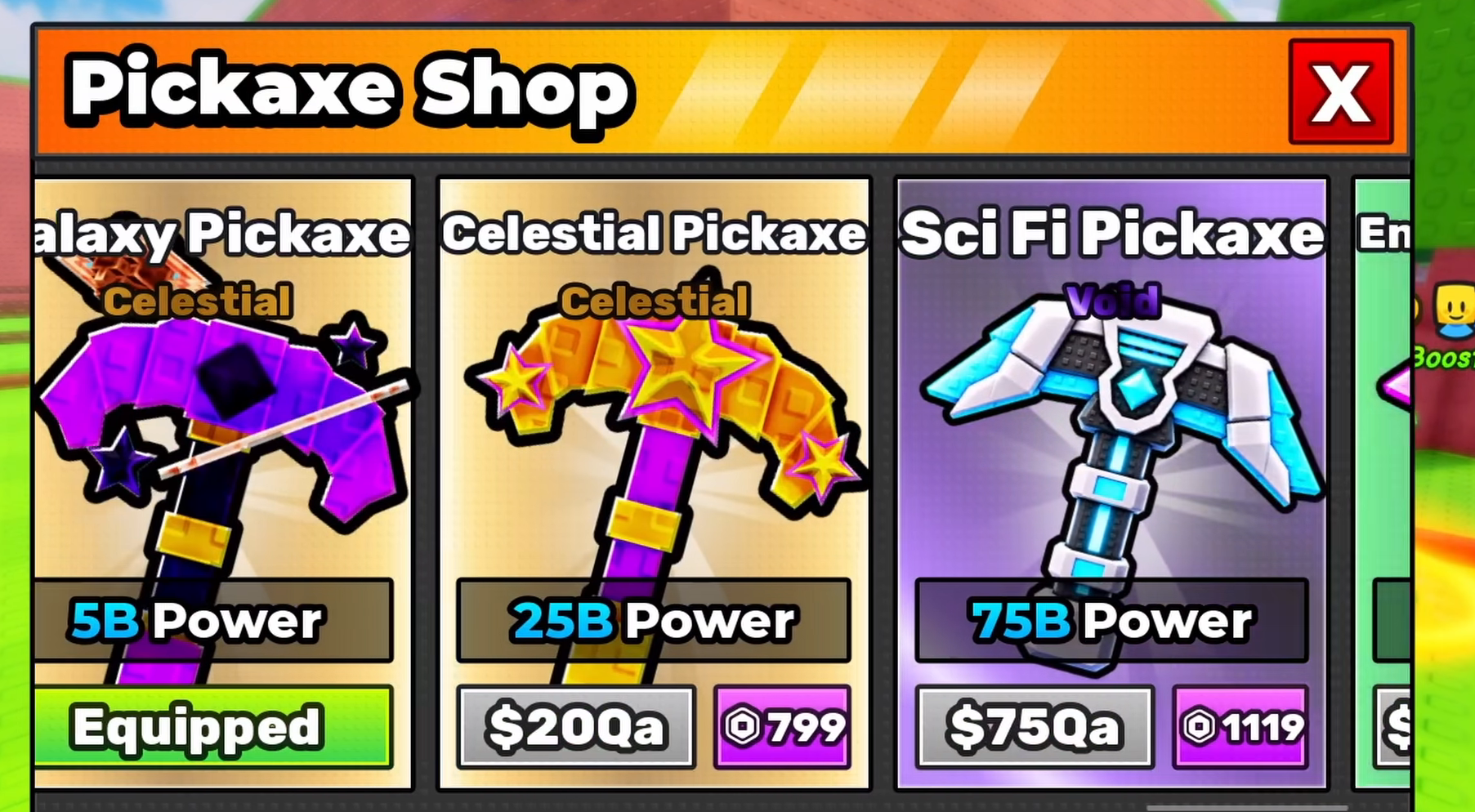
What the frame settles, and what it does not:
- Power goes past the table. The frame shows Galaxy at 5B Power, Celestial at 25B, Sci Fi at 75B, and the edge of Enchanted at 250B. Our table stops at Godly, 15B.
- Galaxy is a 5B tier here. The table calls Galaxy 1B Power for $500T. Same name, different tier, so do not use the table row to find this pickaxe's price.
- Price per Power is no longer monotonic. Celestial asks $200Qa for 25B; Sci Fi asks $75Qa for 75B. Three times the Power for less Cash. The clean "every tier costs more per point" shape holds inside the 18-row table, not across these shop cards.
- Robux sits next to Cash. Celestial 799 and Sci Fi 1119 - both paid tiers, not a free unlock.
- What it does not show. One screen, four cards, two prices cut at the frame edge. It is not the full current ladder, and it does not say whether these tiers are permanent or rotating.
A third-party wiki keeps an undated panel that matches the video on Galaxy and Celestial, and adds a Cool Pickaxe at 1B Power and $600T. Three records, one conclusion: the top of this ladder moves faster than any page can carry, so read the shop in front of you.
Buy Order by Cash Bracket


Each bracket ends where the next pickaxe becomes affordable.
Buy inside the bracket, do not save across two tiers.
- Under $800 — buy Stone, then Iron. $880 covers both. Power goes from 1 to 15, and this is the cheapest Power in the game at $53 per point.
- $800 to $20K — buy Golden. Do not stop to buy anything else on the way. Golden is the last tier where the price per Power is still under $1,000.
- $20K to $160K — buy Diamond. From here the per-point price starts doubling, so take the whole bracket in one purchase instead of dribbling Cash into smaller upgrades.
- $160K to $1.2M — buy Strawberry. This is the flattest step on the ladder (×1.9 against Diamond), which makes it the cheapest relative jump you will get in the mid-game.
- $1.2M to $40M — buy Cactus, then Lightning. Two tiers inside one income band. Buy Cactus first: the ×1.3 step from Strawberry is the smallest increase on the whole table.
- $40M and up — buy only after the Speed check below. Past Lightning, every tier costs more than twice as much per Power point as the previous one.
Which Problem Do You Actually Have?
Four situations look similar in a run and call for opposite purchases. This is our read of the mechanics above, not developer guidance.
Match the symptom to the purchase
4 situationsThe shell breaks in one hit, but you walk between eggs slowly
The shell needs several hits and your Cash is short
The shell needs several hits and you have the Cash
A guard catches you before you reach the egg
When to Stop Buying Pickaxes
There is no universal stop tier, because the game does not publish the Cash price of Treadmill upgrades. What we can give you is the test, using two numbers you can read in-game. You can also run your own Cash, current pickaxe and next tier through the pickaxe planner to get the gap and the price per Power point without doing the division yourself.
- Open the Pickaxe Shop and note the next pickaxe's price. Divide it by the Power it adds over your current pickaxe. That is your current $ per Power.
- Open the Treadmill upgrade and note its price and the Speed it adds.
- If the pickaxe only doubles your Power for a price that would buy several Speed upgrades, buy Speed first.
- If your shell still takes more than one hit after a full combo, buy the pickaxe — travel speed will not fix a Power shortfall.
The test matters most after the Golden tier. Before that, pickaxes are so cheap per point that the comparison almost always favours buying the pickaxe.
Which Zone You Can Farm Sets Your Bracket
Your next pickaxe is paid for by the zone you can already survive. This table is a dated community reference, not official level configuration: it lists the suggested Speed for each zone as published on 2 October 2026, and the eggs recorded there.
| Zone | Suggested Speed | Egg rarity listed | Eggs named |
|---|---|---|---|
| Forest | 5 | Common | Rock; Forest |
| Desert | 1,000 | Uncommon | Cactus; Bones |
| Snowy | 50,000 | Rare | Frozen; Yeti |
| Candy | 750,000 | Epic | Easter Bunny; Candy; Rainbow |
| Swamp | 12,000,000 | Legendary | Gooey; Tree; Lake |
| Ocean | 150,000,000 | Mythic | Sea Stones; Water; Sea |
| Hell | 1,000,000,000 | Divine | Fallen Angel; Angel; Volcanic |
| Blossom | 5,000,000,000 | Cosmic | Blossom; Bamboo; Fortune |
| Galaxy | 25,000,000,000 | Secret | Sun; Starry; Blackhole |
| Planet X | 100,000,000,000 | Celestial | Plasma; Nebula; Supernova |
Two cautions. Suggested Speed is what the zone expects of your movement, not a Power requirement, so do not read it as "you need this pickaxe". And the zone names changed between records — one October source shows Volcano where this table says Hell, and one older screenshot index lists a Frosty Egg for Snowy that the text table does not.
Mistakes That Cost You a Tier
- Saving across two tiers. Cash spent on nothing is a slower breaking rate the whole time. The ladder is monotonic: buy the next tier as soon as you can afford it, up to Lightning.
- Reading Power as damage per hit. It is the shop stat. We have no egg HP table, so a bigger number does not promise one-hit cracks.
- Expecting a pickaxe to swing faster. Swing rate is separate. A paid "Faster Pickaxe Swing" product exists, and its name does not state a frequency.
- Comparing a pickaxe with the zone's suggested Speed. They measure different things. Use the zone table to know where your Cash comes from, not to decide the pickaxe.
- Buying Crystal or above before checking Speed. Past Lightning, one tier costs more per Power point than the tier before it by a factor of two or more.
What This Page Cannot Answer
NOTE
Everything below is a gap in the source material, not a decision to keep the page short. If a later record closes one of them, this page gets longer, not louder.
- Crack times per egg. No egg HP table was available, so no time estimate would be honest.
- Damage per hit versus the Power number. The shop value is recorded; its exact conversion is not.
- Swing frequency. Not published, and the paid swing product does not state a rate.
- A universal stop tier. Treadmill Cash prices are unpublished, so the stop point is a comparison you run in-game, not a fixed tier.
What the page can support is the ladder, the price of Power at each step, and the order to buy in. Those come from the recorded shop table, and the last two columns are arithmetic on it.